A First Loop Around an Unfamiliar Festival Site
A first loop around an unfamiliar festival site helps you read how its spaces connect, choose a meeting point and plan your next move without memorising every path.
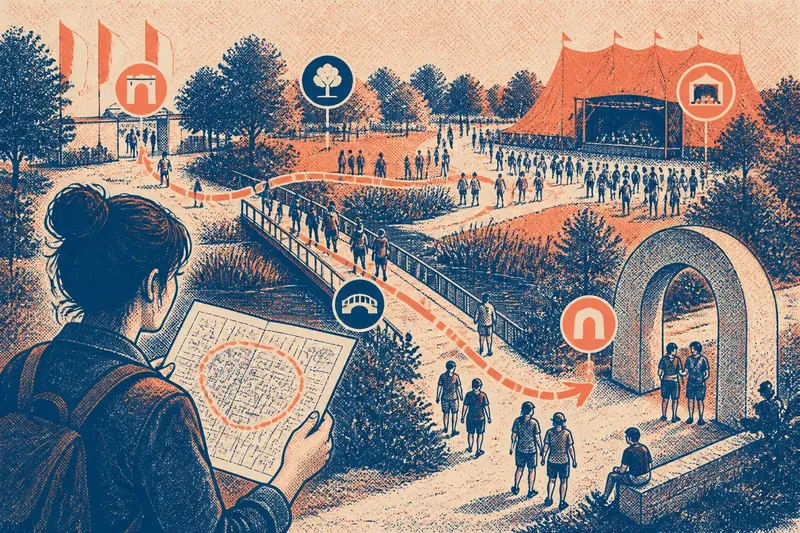
How do you get your bearings at an unfamiliar festival site without turning the visit into a map-making exercise? Make a first loop around the festival site to understand how its spaces connect, rather than to collect landmarks for their own sake. The aim is to notice how you move between areas and where the festival’s activity gathers.
A printed map can show where things are meant to be; a circuit reveals how the transitions feel on foot. You can notice where a lively performance area gives way to a quieter edge, or where a narrow passage opens into a square. Think of the loop as trying a route through a house before guests arrive: the point is to understand how rooms connect, not to inventory the furniture.
Choose a loop that answers one immediate question
Before setting off, decide what you need to learn. Perhaps you want to know whether the performance area is easy to reach from the entrance, where to regroup after a workshop, or whether there is a calmer way between two busy zones. A question gives the circuit a purpose and stops it becoming an aimless march with a wristband.
If you have time before your first event
Walk a broad circuit that takes in the edges and the links between distinct areas. Notice where the ground, width or atmosphere changes. You do not need to enter every space; looking across a courtyard or field may be enough to recognise the transition later.
At each junction, note which direction leads to the area you want and what that connection feels like. A short passage may be direct but busy, while a wider path may be easier to follow. This is the useful distinction: you are learning how the site works as a sequence, not compiling a list of attractions.
If your first event starts soon
Make a compact loop around the event area. Find the route into it, the way back to a main path and a place nearby where you can pause without blocking movement. Then head to the event with time to find its entrance and settle.
A full circuit is not useful if it leaves you arriving flustered. The immediate question is whether you can get into the event and find your way out again; the rest of the site can wait.
If you are meeting someone
Choose a meeting point that is stable and easy to describe, such as the corner of a named courtyard or a distinctive sculpture. Agree on the exact side if the point has several approaches. A popular stall is less dependable because its queue can shift and obscure the view.
Then consider how each person will reach it from the areas where they are likely to be. A point that is slightly off the busiest crossing may be easier to use than one that appears central on a map.
If noise or crowds make it harder to think
Shorten the loop and use wider paths where possible. Pause somewhere out of the flow to check the map, rather than trying to study it while moving. If the site still feels unclear, return to a place you recognise and choose the next leg from there.
Read the links between spaces, not just the landmarks
Useful landmarks are distinct and unlikely to move: a bridge, a prominent building, a sculpture or a change in the paving. But a landmark matters most when you know what it connects. “The mural is beside the passage from the courtyard” is more useful than remembering the mural alone.
Notice how people use the spaces as you pass through. A broad lawn may be a place to wait between events; a paved square may funnel people towards a performance. Look for where people pause, pass through and queue, while remembering that a busy spot is not automatically a good place to stop.
Look for a waiting place outside the main flow, such as a sheltered edge or a low wall. If that spot is crowded, choose a nearby alternative rather than trying to hold a small patch of ground by optimism. The festival’s layout is only part of the picture; an event can change how a space is used.
Turn what you noticed into a flexible next move
After the loop, choose a route based on your next actual plan. Use a familiar connection between areas as your anchor, then decide whether the direct path or a quieter alternative suits the crowd. Keep the rest of the site open for later rather than trying to settle every possible route at once.
Say you arrive with a friend before an outdoor performance. You notice that the entrance path leads through a busy lawn, while a bridge connects the same entrance area to the performance courtyard by a quieter-looking route. You agree to meet beside a sculpted arch at the courtyard’s edge after the performance, and take the bridge so you can both recognise the approach. The resulting decision is clear: use the bridge for arrival, meet at the arch, and avoid relying on the changing crowd in the lawn as a reference.
If a path becomes congested, choose another connection between spaces you already recognise. If you take a detour, return to a familiar junction before continuing. This keeps the loop useful as a working understanding of the site, rather than a route you feel obliged to follow.
What should you do when the connections remain unclear?
Should you walk around the edge or through the middle?
Use the edge when you want to understand where the site begins and ends. Choose a central path if it clearly links the areas you need; if the crowd or layout makes that route hard to read, stay with a connection you can recognise.
How many landmarks should you remember?
Remember only the landmarks that help you connect the places you expect to visit. One at a junction and one near your next destination may be more useful than a longer list of features you have no reason to revisit.
What if a landmark is hidden by a crowd?
Choose a nearby backup and describe its position, such as the side facing the bridge. If the first feature disappears behind a queue or gathering, the backup gives you another way to identify the area.
Should you finish the loop before going to an event?
No. Stop once you know enough to make your next move, especially if an event is about to begin or someone is waiting. You can learn another connection later, when it becomes useful.
Let the first loop stay provisional
A first loop is a way to understand the site’s structure, not a promise that every space will stay as you saw it. Crowds shift, performances draw people in, and a quiet path can become busy. Keep a few reliable connections in mind and adjust when the conditions change.
Before leaving the circuit, identify the familiar space nearest to your next destination. That gives you a practical starting point for the next move, while leaving the festival free to change around you.