The Must-See List Can Hide the Festival Around It
A festival must-see list helps you choose the events that matter while making room to notice local rituals, shared traditions and the life between them.
How do you make a festival must-see list without spending the day obeying it? Start with the events you would regret missing, then consider what the programme leaves out: the customs, meeting places and small acts of participation that give a public celebration its character.
Choose events for a reason, not for their prominence
A headline performance may be exactly why you came. But an event’s prominence is not the same as its personal value. A neighbourhood procession, craft demonstration or communal dance may tell you more about the festival’s traditions than another large stage appearance.
Write down why each priority matters. “I want to hear this ensemble” is clearer than “everyone says it is essential”. If local customs interest you, look for events where people take part, not only watch. If you are there for a relaxed afternoon, a plan built around several fixed start times may not fit.
Separate genuine priorities from appealing possibilities. That distinction gives you a way to choose when events overlap, and stops every attractive listing from becoming a personal emergency.
Notice what the programme cannot schedule
Festival programmes make events legible: they give a name, a place and a time. Shared traditions often unfold less neatly. Neighbours may greet one another in a familiar square; a procession may draw spectators into its route; a food stall may become a meeting point for people who return each year.
These details are not substitutes for the advertised events. They are part of the celebration’s social life. Watch how people use a space, whether an activity invites participation and which customs seem familiar to local attendees. You do not need to know every reference to appreciate that a ritual connects people to one another and to a place.
A programme is a little like a map of a market: useful for finding the stalls, but not a record of every conversation happening between them.
Make a short priority list and a workable route
Choose the events that need a firm commitment, then check the festival map and current programme. Note venue changes, access arrangements and whether an event has timed entry or limited capacity. For anything controlled by organiser instructions, follow the information provided on site.
- If an event has a fixed start or timed entry, check its location and access details; if you can meet them, keep it as a priority, and if not, choose an accessible alternative.
- If two priorities overlap, compare which one best matches your reason for attending; if one clearly matters more, attend it, and if they remain equal, choose one and release the other.
- If the route between venues looks uncertain, check the festival map and ask an organiser; if the transfer seems workable, keep both events, and if not, drop the less important booking.
- If a listing describes a drop-in activity, check whether you can arrive partway through; if you can, treat it as optional, and if you cannot, plan around its stated start.
- If a friend or family member has a different priority, agree which event each person will attend; if splitting up is comfortable, meet afterwards, and if not, choose a shared event.
- If an event is cancelled or moved, check the updated programme; if a replacement suits your original purpose, choose it, and if it does not, use the time for a nearby gathering or a rest.
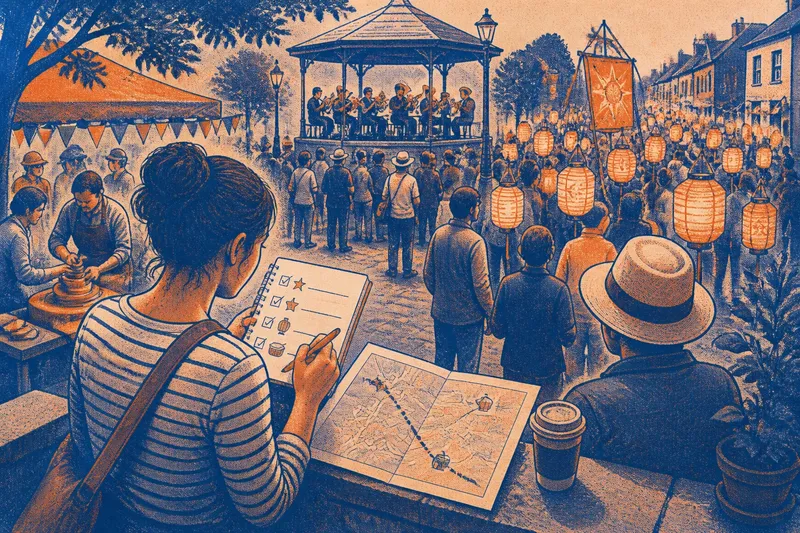
Say you are visiting a town festival to hear a brass ensemble and see a lantern procession. You check the programme, find that the ensemble has a fixed start in the central square, and confirm that the procession begins later from the market street. You mark both as priorities and note a courtyard demonstration between them as a drop-in option. On arrival, the demonstration is already under way and holds your interest, so you stay briefly; the resulting plan still leaves time to reach the procession, while the ensemble remains the day’s one firm commitment.
Let the ritual set the pace
Some public rituals reward arriving early and watching how a gathering forms. Others make more sense once you understand where spectators are meant to stand or whether participation is invited. Read the programme description, look for signs and listen to organisers rather than assuming that every crowd-facing event has the same rules.
When a ceremony begins, notice the sequence as well as the spectacle: who leads, who responds, and how the audience is included. If you are unsure whether to join in, follow clear cues or ask an organiser. Respecting the form is more useful than trying to turn every moment into an activity.
Which festival events deserve a fixed place?
How do I choose between events at the same time?
Choose the event most closely tied to your reason for attending, then check whether the other is repeated or available in another form. If neither is, make a deliberate choice rather than trying to attend both and arriving late to each.
Should I attend an event because it is popular?
Popularity can tell you that many people are interested, but it cannot tell you whether the format or subject suits you. Read the listing and decide on those details, not on prominence alone.
What if I worry about missing something?
Keep the list to events you would genuinely regret missing; treat the rest as options. You can ask an organiser or local participant what is happening nearby, then decide whether that suggestion fits your interests and the festival’s customs.
Is time without a booking wasted?
No. It can give you time to rest, observe a ritual or spend a while in a public space without checking the clock. If nothing catches your attention, a pause still has a purpose.
Review the list before you leave
Check that your festival must-see list reflects your interests, the venue locations and any access requirements. If a change removes a priority, consult the latest programme before choosing a replacement; the nearest listing may not be the right one. A smaller gathering, a conversation or a moment watching the square fill can be more meaningful than another booking.
Before heading home, consider what you noticed beyond the scheduled events. The answer may be a familiar greeting, the way a crowd made room for a procession, or a ritual whose meaning became clearer as you watched. That is useful context to carry into the next festival, whether or not it earns a line on your list.