Why Festival Entrances Set the Pace Before the First Event
Festival entrances set the pace before a programme begins. Learn how gates, welcome points and visible cues shape expectations and help visitors orient themselves.
Where should you enter a festival if you want to feel oriented rather than hurried? Festival entrances set the pace before the first event, through the shape of the arrival point, the cues visible from it and the room visitors have to pause. A gate, a welcome point and an open approach each make a different promise about what comes next.
That promise need not be grand. A clear view of a main path can make a new site feel legible; a narrow passage opening onto a busy square can make it feel lively, or simply busy. The entrance is not a summary of the festival. It is the first practical instruction visitors receive, often before they have read a sign.
A gate gives the arrival a clear threshold
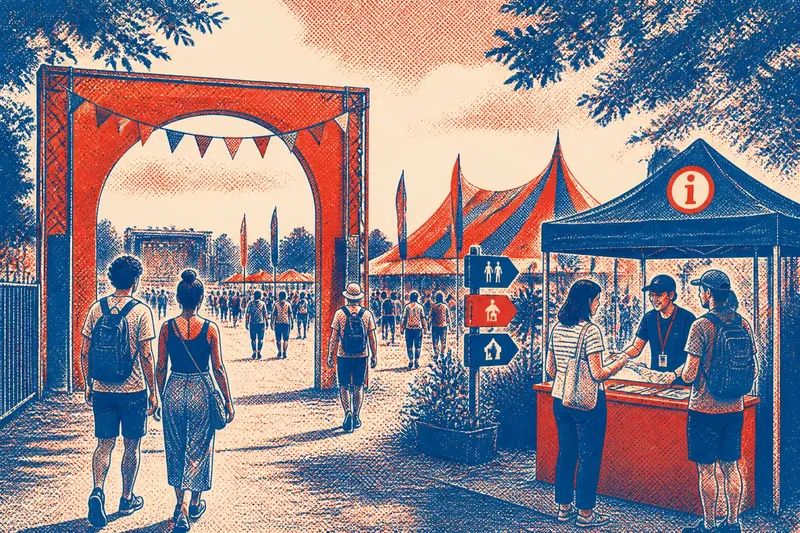
A defined gate tells visitors, “You are entering now.” Fencing, an arch, a ticket point or a change in paving can mark the boundary between ordinary street and festival space. The effect is useful when the event occupies a large field, a closed road or a site with several unrelated entrances. Visitors can identify where to begin, and staff can distinguish the public arrival route from service access.
Gates also create a natural pause. People may need to show a ticket, collect a wristband or wait for companions. If the pause happens in a broad forecourt, the entrance can absorb that small uncertainty without making the path behind it unusable. If the same checks sit in a narrow corridor, a short delay can feel like the whole event has stopped. The gate is a little like a book cover: it signals a change of setting, but it cannot tell you what every page contains.
A formal boundary suits festivals where admission, security or a distinct sense of occasion matters. It may suit a ticketed music event or a fair with several controlled access points. It is less helpful when the event’s appeal depends on wandering in from a neighbourhood street and encountering activity gradually. A strong threshold can make entry unmistakable, but it can also make a public celebration feel more sealed off than its organisers intend.
A welcome point makes orientation part of arrival
A welcome point is a visible place to ask a question, collect information or get bearings. It might be a staffed table, a freestanding sign, a recognisable canopy or a cluster of volunteers near the first junction. Unlike a gate, it does not have to define the site’s boundary. Its job is to reduce the distance between arriving and knowing what choices are available.
This approach suits a festival with multiple stages, workshops or family areas, especially if visitors are likely to arrive at different entrances. A welcome point can establish a recognisable reference across the site: look for the same symbol, colour or name wherever you enter. It also helps people who need practical information rather than a ceremonial welcome, such as the location of accessible routes, toilets or a quiet area.
Visibility matters more than elaborate styling. A table hidden behind a food queue is technically present, but not much of a landmark. Staff should be able to stand where they can see people approaching and direct them without blocking the route. Signs can support the point, but they should not compete with one another. A visitor who sees three arrows pointing in different directions has been given options, not orientation.
Say you arrive at a street arts festival with a child who wants to find the puppet show, while you need to check the accessible route. If the entrance opens beside a clearly marked welcome canopy, you can pause there, ask both questions and choose a direction before joining the crowd. The expected result is a more settled start, not a promise that the site will stay quiet or that every destination will be close by.
An open approach lets the festival reveal itself gradually
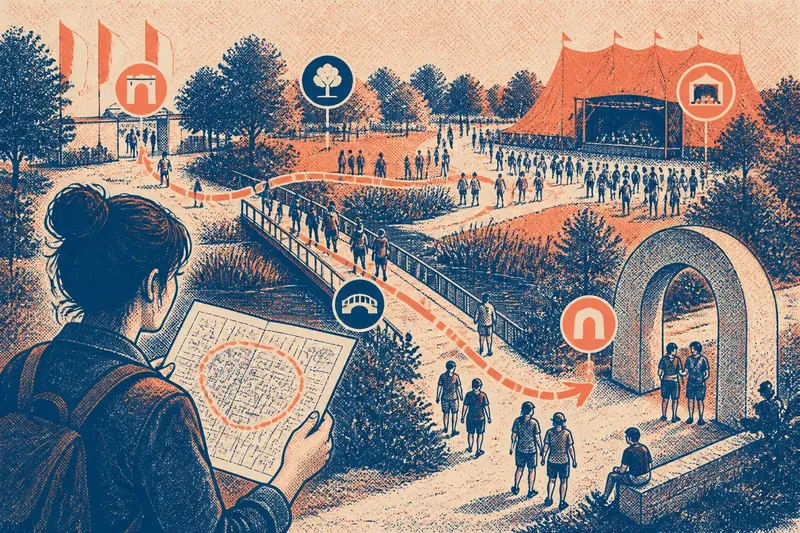
Some events use no obvious gate or central welcome point. Instead, a path, line of lanterns, sound from a stage or view of activity draws people in. An open approach can make an event feel woven into its surroundings rather than placed behind a boundary. It is especially suited to neighbourhood festivals, outdoor arts trails and celebrations spread across streets or public squares.
Its strength is discovery. Visitors can notice activity before committing to a particular route, and people who were not planning to attend may find a reason to stop. The trade-off is that “come in” can be less clear than organisers expect. A path may look like a service lane; a performance may be audible without revealing where the audience should stand. The atmosphere can be welcoming while the practical geography remains obscure.
Open approaches benefit from a few deliberate cues: a sign at the point where the route becomes part of the event, a map at a natural pause, or a visible steward near a confusing fork. These need not turn a loose celebration into a sequence of checkpoints. They simply make the first decision easier to read. If a festival spans several blocks, repeated names for the main areas can help visitors understand that they have moved from one part of the event to another.
Choose the entrance approach that matches the first decision
The most useful comparison is not which entrance looks grandest. Ask what visitors need to do first. If they must pass a controlled point, a defined gate makes that action legible. If they need help choosing among several destinations, a welcome point gives them a place to orient themselves. If the event should feel like an invitation to explore, an open approach can preserve that quality, provided its first cues are easy to recognise.
- Choose a defined gate when admission or a clear boundary is central to the event, and make room for visitors who need to pause.
- Choose a welcome point when the site has several destinations or visitors are likely to need individual directions.
- Choose an open approach when the festival is distributed through a public place and discovery is part of the experience.
- Combine approaches selectively when a boundary is necessary but visitors also need a visible place for questions beyond it.
Before settling on an arrangement, consider what is visible from the point where people first arrive: the event boundary, the main route, a staffed help point or the next place to pause. Consider, too, whether people may approach from more than one direction. An entrance that works for someone arriving from a station may be difficult to spot for someone coming from a side street.
What do visitors need to know on arrival?
Should every festival have one main entrance?
No. A single entrance can make a compact, controlled site easy to understand, but a spread-out event may need several arrival points. If there are several, use consistent signs and naming so visitors can recognise that each is an entrance to the same festival.
What should the first sign explain?
It should answer the immediate question: where am I, and where can I go from here? A short site name and a few useful directions usually help more than a full programme placed where people are still deciding where to stand.
How can an entrance feel welcoming without looking formal?
Use human-scale cues such as a visible steward, a clear route marker or an open place to pause, rather than relying on a large structure. The approach can remain informal while still making the event’s public route apparent.
When should a festival use both a gate and a welcome point?
Use both when the gate handles a necessary boundary and visitors still need help choosing what to do after entry. Keep the welcome point visible from the gate, so people do not have to guess whether they should continue walking or stop for directions.
Make the first cue useful, not merely decorative
A distinctive entrance can set a mood, but its first practical cue should still be readable. A sculptural arch may draw the eye; it does not replace a sign if visitors cannot tell whether they are entering the event or passing by it. Similarly, music can create a sense of arrival without showing where the audience should go. Mood and information can share the space, as long as one does not obscure the other.
When the event’s access arrangements, site layout or local requirements affect the entrance design, organisers should follow the relevant venue instructions and local rules. Beyond those constraints, the choice is about the kind of first decision visitors face: pass through, ask for direction or follow a trail of clues.
For anyone comparing festival entrances, the useful question is not whether the arrival looks impressive in a photograph. It is whether a visitor can tell what to do next without feeling pushed into a choice. A well-considered threshold lets people begin at the festival’s pace, rather than at the pace of the queue, the loudspeaker or the person behind them.